

Request a representative visit or G7 15 Day or G7 samples
CSS Do not remove


Dexcom G7 15 Day: A win for adult patients with diabetes, regardless of insulin use*,1
Diabetes during pregnancy

Dexcom G7 15 Day is the only CGM† with proven accuracy and safety in pregnancy2,3
In patients with type 1, type 2, or gestational diabetes4
Diabetes during pregnancy can increase risks for mothers and babies2,3,5-10
Dangers for mothers

Cesarean delivery5

Preeclampsia‡,2,3,6-9

Preterm birth‡,2,3,6-9
Dangers for unborn babies

Risk of stillbirth10

Risk of shoulder dystocia10

Risk of large gestational age (LGA)†,2,3,6-9

Less time in the NICU3
Diabetes can take a toll on expectant mothers’ health11,12
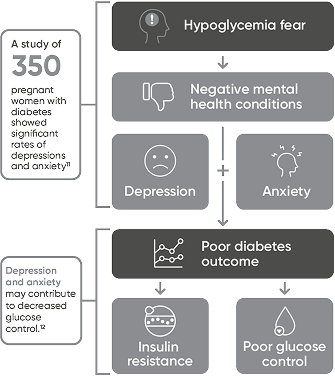
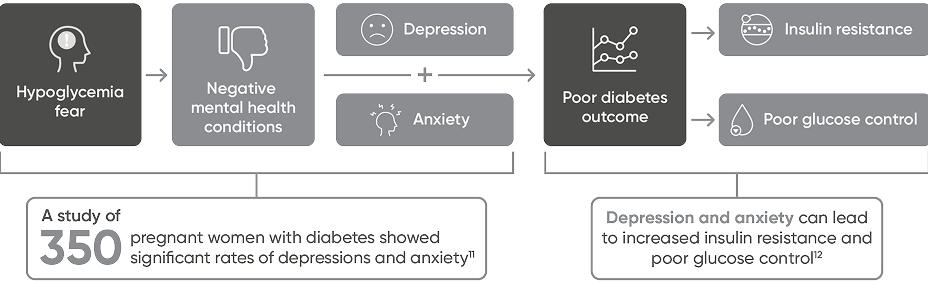

Using Dexcom CGM may help pregnant patients with diabetes achieve better glucose control.2,6-8,13,14
The only CGM† proven safe and accurate for pregnant patients2
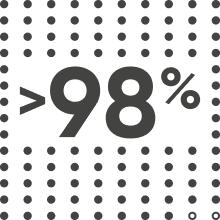
of glucose readings
may be missed with BGM§,15

Better glycemic control
by adjusting treatment and lifestyle behaviors, without fingersticks||,2,6-8,13,14

15 days of wear¶,#,16,17
safe and accurate across glucose ranges and pregnancy trimesters2
Why CGM for pregnant patients with diabetes?
CGM provides the complete 24-hour picture to help your patients address spikes or troughs BGM can miss4,18
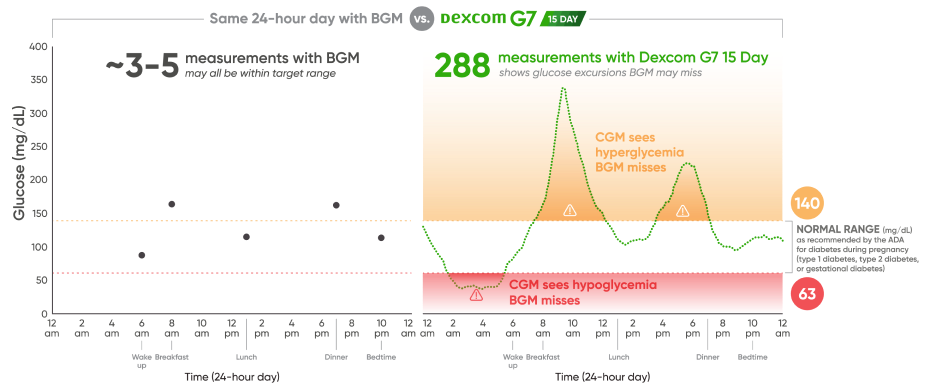
Illustrative model of a 24‑hour blood glucose profile; not derived from an actual patient dataset.

Pregnancy glycemic control goals: Safely increase TIR quickly while reducing glycemic variability.18
Trust the only CGM proven to be safe for pregnant patients with diabetes†,2
Lower risk to the mother

Hyperglycemia2,14

Preeclampsia†,2,19

Gestational weight gain‡,14,20
Rate of C-sections‡,2,19
Lower risk to the baby

LGA‡,21
Neonatal hypoglycemia21
NICU admissions21

Coverage and Affordability
Extensive coverage through a broad range of commercial and Medicare plans**

Ready to Prescribe?
ADA=American Diabetes Association; BGM=blood glucose monitoring; CGM=continuous glucose monitoring; NICU=neonatal intensive care unit; TIR=time in range.
*In a retrospective study, diabetes-related hospitalizations reduced 12 months after CGM use: Non-insulin (-31%) basal insulin (-48%) prandial insulin (-53%).1 †Based on commercially available CGMs that have completed clinical trials evaluating accuracy and safety in pregnant patients with diabetes. ‡Studies have demonstrated an association between elevated glucose and increased incidence of cesarean delivery, preeclampsia and birth weight >90th percentile. §Based on a person testing blood glucose 5x a day vs. 288 readings using Dexcom CGM. ||Fingersticks required for diabetes treatment decisions if symptoms or expectations do not match readings.4 ¶A study was conducted to assess the sensor life where 73.9% of sensors lasted the full 15 days. In other words, when using the product per the package labeling, approximately 26% of sensors may not last for the full 15 days. #Excludes implantable CGM systems. **Individual pricing may vary depending on commercial insurance coverage.
1 Garg SK, et al. Diabetes Obes Metab. 2024;26(11):5202-5210. 2 Polsky S, et al. Diabetes Technol Ther. 2024;26(5):307-312. 3 Hapo Study Cooperative Research Group, et al. N Engl J Med. 2008;358(19):1991-2002. 4 Dexcom G7 15 Day User Guide. 5 Gonzalez-Quintero VH, et al. Diabetes Care. 2007;30(3):467-470. 6 The American College of Obstetricians and Gynecologists. Obstet Gynecol. 2018;131(2):e49-e64. 7 Beck RW, et al. JAMA. 2017;317(4):371-378. 8 Beck RW, et al. Ann Intern Med. 2017;167(6):365-374. 9 Welsh JB, et al. J Diabetes Sci Technol. 2024;18(1):143-147. 10 Hussain SA, et al. Case Rep Obstet Gynecol. 2020;8142109:1-5. 11 Salimi HR, et al. Diabetes Epidemiol Manage. 2024. 12 OuYang H, et al. J Diabetes Res. 2021;995779:1-10. 13 American Diabetes Association. Standards of Care in Diabetes. Diabetes Care. 2023;46:S1-S291. 14 Feig DS. Diabetes Care. 2022;45(11):2484-2491. 15 Dexcom G7 User Guide. 16 Data on file (VV-07561). Dexcom; 2025. 17 Data on file (VV-07558). Dexcom; 2025. 18 Battelino T, et al. Diabetes Care 2019;42:1593-1516. 19 Yu F, et al. J Clin Endocrinol Metab. 2014;99(12):4674-4682. 20 Wei Q, et al. Sci Rep. 2016;6:19920. 21 Murphy HR. Diabetologia. 2019;62(7):1123-1128.