


Request a representative visit or G7 15 Day or G7 samples


Why CGM is important for taking control of glucose management in adults with diabetes
Image

The 2026 ADA Guidelines recommend CGM use in adult patients with diabetes1
ADA recommends CGM to improve outcomes, reduce hypoglycemia, and reduce treatment burden.1
Type 1 diabetes

For all patients
Use as early as diagnosis, even if presymptomatic1
Type 2 diabetes

Those who use insulin
Patients who use insulin should use CGM daily as much as possible1

Those who do not use insulin
- Patients on non-insulin injectable glucose-lowering medications1
- Patients on oral glucose-lowering medications1
BGM vs. CGM

BGM may allow dangerous glucose excursions to go unnoticed. CGM can help.
CGM’s continuous 24-hour monitoring catches the spikes and lows that BGM may miss while building a picture of day-to-day trends2

Illustrative model of a 24-hour blood glucose profile; not derived from an actual patient dataset.
Unlike BGM, CGM reveals glucose variability to help reduce excursions3
BGM: 3-5 readings a day
- Provides 1 measurement at 1 point in time
- Detects neither direction nor rate of glucose changes, nor trends
- BGM may miss up to 98.3% of glucose readings daily*
- Requires multiple fingersticks daily
CGM: 288 readings a day3
- Predicts lows and may allow for corrective action2
- Also tracks TIR and glucose variability4
- Encourages positive diet and exercise changes†,5
- Improves physician-patient partnership6
A1C and TIR
A1C and BGM don’t tell the full story
of your patients’ glucose control
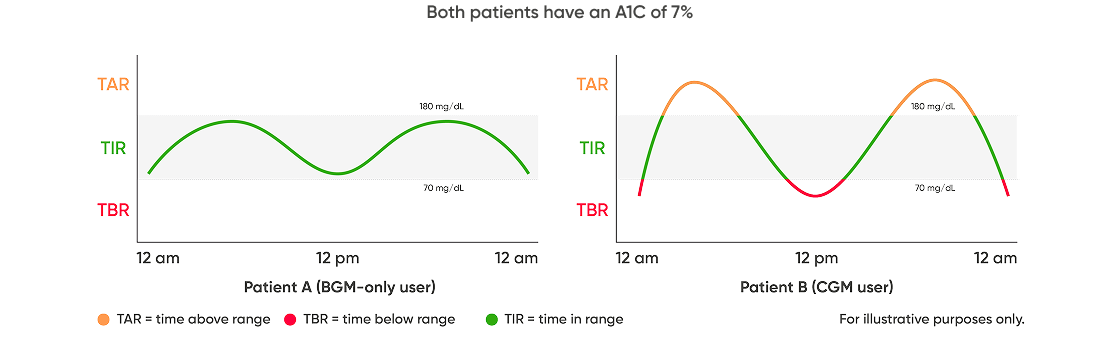
Two patients who have the same A1C can spend different amounts of time in range (TIR).
A1C measures a patient's average glucose percentage over the past 8-12 weeks. Time in range reveals the percentage of time a person with diabetes spends within their target glucose range (typically between 70 and 180 mg/dL). Time in range shows a more accurate view of the length and severity of their glucose fluctuations. This is most efficiently done using CGM.7
Both patients have an A1C of 7%


42 Factors
42 factors that may affect blood glucose8
Not everyone responds to glucose changes the same way, and there are often day-to-day variations. Certain factors may also apply more to patients with type 1 vs. type 2 diabetes. The best way to see how a factor affects a patient is through personal experience, frequent blood glucose checks, and by wearing a CGM to identify patterns.‡,8

Food
Carbohydrate quantity
Carbohydrate type
Fat
Protein
Caffeine
Alcohol
Meal timing
Dehydration
Personal microbiome
neutral
increasing
decreasing
undetermined

Medication
Dose
Timing
Interactions
Steroid administration
Niacin (vitamin B3)
neutral
increasing
decreasing
undetermined

Activity
Light exercise
High-intensity & moderate exercise
Level of fitness training
Time of day
Food and insulin timing
neutral
increasing
decreasing
undetermined

Biological
Too little sleep
Stress and illness
Stress and illness
During-sleep blood sugars
Dawn phenomenon
Infusion-set issues
Scar tissue/lipodystrophy
Intramuscular insulin delivery
Allergies
A higher glucose level
Menstruation
Puberty
Celiac disease
Smoking
neutral
increasing
decreasing
undetermined

Environmental
Niacin (vitamin B3)
Timing
Interations
Niacin (vitamin B3)
Personal microbiome
neutral
increasing
decreasing
undetermined

Behavior & Decisions
More frequent BG checks
Default options and choices
Decision-making biases
Family and social pressures
neutral
increasing
decreasing
undetermined
‡The arrow show the general effect these 42 factors seem to have on blood glucose based on scientific research and/or the experiences of diaTribe. Not every individual will respond in the same way, so the best way to see how a factor affects your patients is through their own data: patients should check their blood glucose often and look for patterns. Adapted from diaTribe website.

Explore G7 15 Day
See how Dexcom’s newest CGM can help your patients

See Patient Outcomes
View CGM outcomes in patients with type 2 diabetes not using insulin

Coverage & Affordability
Extensive coverage through a broad range of commercial and Medicare plans§,9,10
A1C=hemoglobin A1C; ADA=American Diabetes Association; BGM=blood glucose monitoring; CGM=continuous glucose monitoring; TIR=time in range.
*Based on a person testing blood glucose 5x a day vs. 288 readings using Dexcom CGM. †55% of participants surveyed wore Dexcom CGM. §Individual pricing may vary. Coverage may vary by insurance.
References: 1. ADA PPC_7. Diabetes Care. 2026;49(Supp 1):S150-S165. 2. Pettus J, et al. J Diabetes Sci Technol. 2017;11(1):138-147. 3. Dexcom G7 15 Day User Guide 2025. 4. Battelino T, et al. Diabetes Care. 2019;42(8):1593-1603. 5. Ehrhardt N, et al. Clin Diabetes. 2020;38(2):126-131. 6. Cowart K, et al. Expert Rev Med Devices. 2021;18(11):1049-1055. 7. Cleveland Clinic. 2024. Accessed August 20, 2026. https://my.clevelandclinic.org/health/articles/time-in-range-diabetes 8. Brown A. The diaTribe Foundation. 2022. Accessed August 20, 2026. https://diatribe.org/diabetes-management/42-factors-affect-blood-glucos… 9. Data on file, Dexcom. 2025. 10. Data on file, Dexcom. 2026.
MAT-16467