
Request a representative visit or G7 15 Day or G7 samples
When is the integration of iLet with Dexcom G7 available?
Monday, December 18, 2023

Monday, December 18, 2023
Patient background

Claudia, a 72-year-old female who lives alone and loves to garden. She has a history of level 3 hypoglycemia that required assistance.
Current treatment: Glipizide and metformin
Current A1C: 7.4%
Scenario
Claudia was planting flowers in her yard when she felt shaky and decided to sit down. A neighbor saw her sitting and looking disoriented and went over to see if she was ok. Claudia said she needed juice or the sugar tablets, which her neighbor quickly retrieved from her kitchen. She drank 4 ounces of juice and ate 2 glucose tabs. Once she felt a bit better, she realized she took her sulfonylurea at lunchtime but got sidetracked planting before she ate. She knew she had experienced very low glucose and decided to call her doctor to discuss.
She went in for an appointment the next day and told her doctor she’s had similar episodes before, and thinks she might have also been low those other times. Her doctor documented in the office visit note that Claudia has had level 3 hypoglycemia that required assistance, then prescribed Dexcom G7. She started on Dexcom G7 as soon as her shipment arrived.
Why Dexcom G7 was prescribed
Expanded Medicare coverage criteria* includes level 3 hypoglycemic events that require assistance and are documented in the office note.
How Dexcom CGM helped
Claudia now uses Dexcom G7 consistently and gets alerts if her glucose drops quickly or will be urgently low soon, so she can take action to avoid hypoglycemia. She also gets a low alert that she set to go off when she drops to 85 mg/dL.
Another feature of Dexcom G7 that Claudia says eases her mind and gives her comfort is that the Dexcom G7 mobile app allows her to share her CGM data with up to 10 followers.|| At this time, her neighbor and daughter follow her and get alerted if she is low so they can check in on her.
Patient background

Steve, a 68-year-old male who is very active. Despite being prescribed basal and mealtime insulin, he doesn’t take it due to fear of hypoglycemia.
Current treatment: Metformin, basal insulin (degludec), and meal-time insulin (lispro)
Current A1C: 8.9%
Scenario
Steve is competitive in tennis and teaches tennis lessons. He would run his glucose levels “really high” by not taking meal-time insulin due to fear of hypoglycemia while competing. Steve’s doctor asked him to check his glucose prior to tennis competitions and note what his numbers generally were. He was consistently over 300 mg/dL and comfortable with this because he knew he didn’t have to worry about having a low.
His doctor prescribed Dexcom G7, so Steve then had what he referred to as a “safety net” with the Urgent Low Soon and Falling Rate alerts. His first goal was for his glucose number to be less than 200 mg/dL prior to his competitions.
Why Dexcom G7 was prescribed
Expanded Medicare coverage criteria* includes anyone with diabetes treated with any insulin.
How Dexcom CGM helped
Steve was able to better manage his glucose levels prior to exercise and increase his time in range because he was ok starting tennis at a lower glucose level. He also has less frequent lows, because now he knows he can eat carbs when he gets an Urgent Low Soon alert. Dexcom G7 alerts help him worry less and feel better out on the court knowing he’ll get an alert if he is going too low.
This was a gradual process of adjusting his alerts and glucose goals. Once he started competing in a glucose range that wasn’t so high, Steve reported that he felt better and his performance improved. He also made other changes to food choices that he noticed were giving him high glucose after eating. Looking at trends and patterns on Dexcom Clarity reports¶ helps Steve see how much time he is spending in target range as well as where he could improve.
Patient background

Rebecca is a 67-year-old female who was diagnosed with T2D 12 years ago.
Current treatment: Metformin 1000 mg BID, Sitagliptin 100 mg QD, Glimepiride 4 mg BID, basal insulin (glargine) 36 units QPM
Current A1C: 9.8%
Scenario
Rebecca is motivated to manage diabetes but struggles with eating lower carbohydrate foods consistently. She’s busy with volunteering activities and her new post-retirement social life. When Rebecca was working, she kept her blood glucose meter at her desk and would check her glucose 1-3 times daily. Nowadays, she often forgets to bring the meter with her when she’s out and about.
Why Dexcom G7 was prescribed
Rebecca’s primary care provider (PCP) recognizes her desire to better manage her diabetes and wants to provide a tool that shows her glucose patterns and trends. Her PCP believes Rebecca can use that information to adjust her medications and improve overall glycemic management. In addition, expanded Medicare coverage criteria* includes anyone with diabetes treated with any type of insulin.
How Dexcom CGM helped
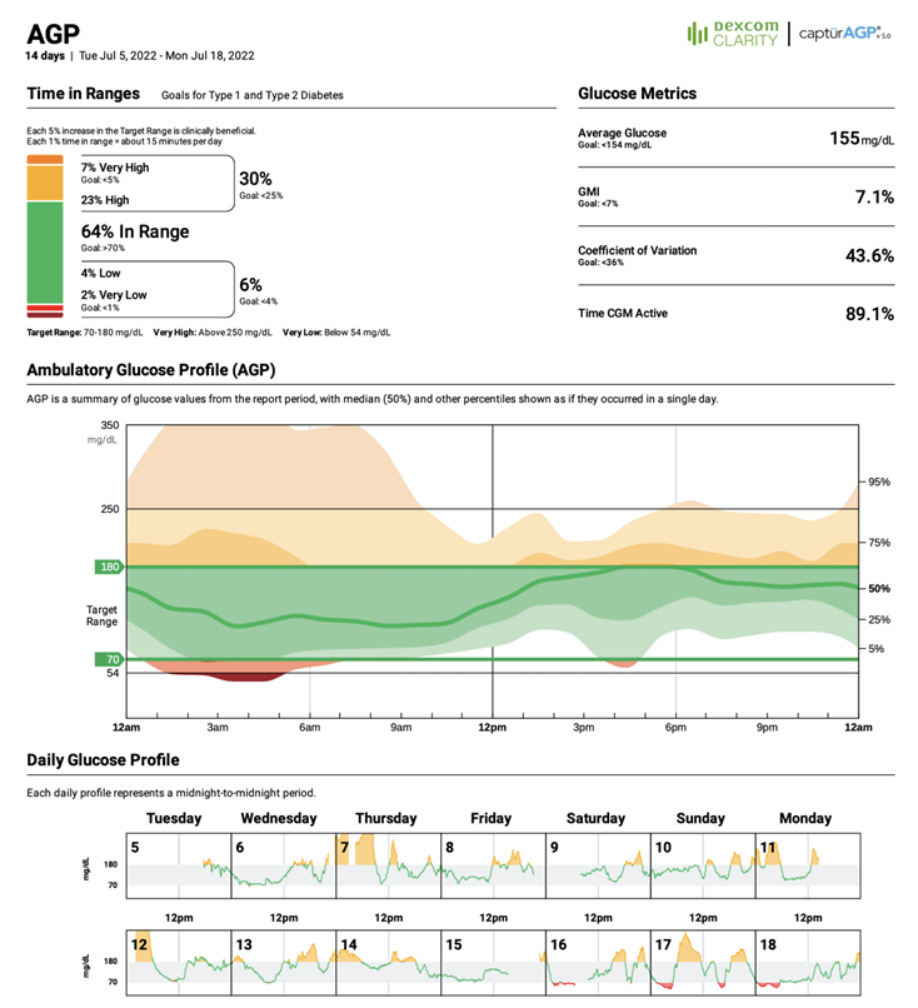
Glucose patterns and trends shown on Dexcom Clarity reports allowed Rebecca’s PCP to see what areas to improve and made medication adjustments to address her persistent evening and overnight hyperglycemia.# Her new medication plan included changing glimepiride to dapagliflozin (SGLT-2i), changing sitagliptin to semaglutide (GLP-1 RA) 0.25 mg titrated up to 1 mg weekly, continue on Dexcom G7, and follow up in 3 months.
At 3-month office visit, Rebecca’s A1C had decreased to 7.2% with improved postprandial hyperglycemia. Her Dexcom Clarity reports showed overnight hypoglycemia and glycemic variability. Her PCP recommended reducing her basal insulin to 18 units QPM and continuing with lifestyle modifications. Rebecca is now using Dexcom G7 to guide meal choices and thanks to Dexcom G7 alerts, she can intervene earlier to prevent or minimize hypoglycemia episodes.
Patient background

Doug is a 68-year-old male who was diagnosed with type 1 diabetes 47 years ago.
Current treatment: Degludec 40 units daily at bedtime, Aspart 1 unit per 10 grams carbohydrate plus correction of 1 unit per 50 mg/dL over 150 mg/dL at meals
Current A1C: 7.2%
Scenario
Doug has been living with type 1 diabetes since early adulthood when he was diagnosed. He has been on multiple daily insulin injections and using a blood glucose meter (BGM) to check his glucose numbers since diagnosis and his outlook is, “if it’s working, why change what I’m doing?” Doug eats well-balanced meals and feels he’s doing everything he can to take care of his diabetes.
Sometimes, Doug is unsure if he is experiencing hypoglycemia and it worries his wife that he’s not as aware of the symptoms as he used to be. He is stubbornly independent and doesn’t want much help from others, especially when it comes to diabetes management.
Why Dexcom G7 was prescribed
Doug told his primary care provider that he feels like his glucose numbers aren’t as steady as they used to be, and he can’t figure out why. His doctor told him that Dexcom CGM could give them both insight into what’s happening with his glucose levels in between fingerstick checks with his BGM.
Doug was curious to see how CGM could help, and decided to give it a try since it’s covered by Medicare.*
How Dexcom CGM helped
For the first time since being diagnosed, Doug was able to get a clearer picture of what was happening with his glucose levels throughout the day and night. He had no idea that eating oatmeal with banana slices for breakfast caused his glucose to spike to over 250 mg/dL, and it took a few hours to get back in range.
Before CGM, Doug only saw the numbers in the low 100s before he ate and the 100s before lunch. Doug admits, “I was under the impression that all my blood sugars were in range based on the numbers I was seeing on my meter, and my A1C being around 7%. I can now see that I have some pretty big spikes after what I thought were healthy meals. I’m going to experiment to see what I can eat for breakfast that won’t cause such a spike.” Doug was surprised that he felt comfort in being able to always see his current glucose number and the direction it’s heading. This caused him to worry less when he was busy and not wanting to interrupt his day to use his BGM.
Doug’s wife was glad he eventually allowed her to follow his Dexcom G7 data and be alerted if he gets an Urgent Low Alarm. Doug likes that he can decide what alerts his wife receives, and that she’s not nagging him as much about his numbers because she can see them on the Dexcom Follow app.
Compatible Dexcom G7 sensors are expected to be available through the VA pharmacy in early January 2024. Do not update your patients CGM supplies to Dexcom G7 until notified that compatible G7 sensors are available at the VA pharmacy. The Dexcom G7 integration software update on the t:slim X2 pump is compatible with both G6 and G7, so your patient can update their pump software and continue to use Dexcom G6 until Dexcom G7 is available at the VA.
Dexcom G6 sensors are compatible with the t:slim X2 pump and are currently available through the VA pharmacy. Please send your patients prescription for Dexcom G6 to the pharmacy and have your patient submit an order for t:slim X2 to the prosthetics department.
Your patient's DME distributor may be able to use the current order on-file to upgrade to Dexcom G7. The DME distributor can confirm if a new order is needed to upgrade. If a new order is needed, the distributor can fax a request to you for a Dexcom G7 order.
Your patient's current DME distributor can confirm when they are eligible to fill the next order for CGM supplies.
To determine if a smartphone is compatible with Dexcom G7, please visit https://www.dexcom.com/en-us/compatibility